
Game reference
Andar Bahar
A matching-card game reference; check the rules of the named version.
Provider named in the source catalogue: KA Gaming.
Source: Jackpotter game catalogue.
Read the source version’s current rules. This reference does not establish availability, game configuration or payout terms for another service.
Return to the game collection →Indibet Card Games covers Teen Patti, Andar Bahar and Rummy alongside cricket.
The provider examples below are independent illustrations of game mechanics, not confirmed Indibet suppliers or inventory.
TeenPatti Royale: Blind and seen
A Teen Patti Royale table opens with a shared pot, and each seat receives three face-down cards. A player who has not viewed those cards is blind; one who has looked is seen. The blind status can change to seen at the player's choice, and that switch alters which stake limits apply.
A blind player may stake one or two times the current stake, while a seen player may stake two or four times. Consider a current stake of 10: the blind range is 10 to 20, and the seen range is 20 to 40, so viewing cards raises the permitted outlay.
Packing ends a player's interest in the pot. Chips already contributed stay behind rather than returning to the packer. If a player has put 60 into a pot and then packs, that 60 remains available to whoever eventually wins the hand, which makes an early exit a settled loss rather than a refund.
The three-card deal, the blind and seen distinction and the packing rule together explain why two players at one table can commit very different amounts.
TeenPatti Royale: Hand order
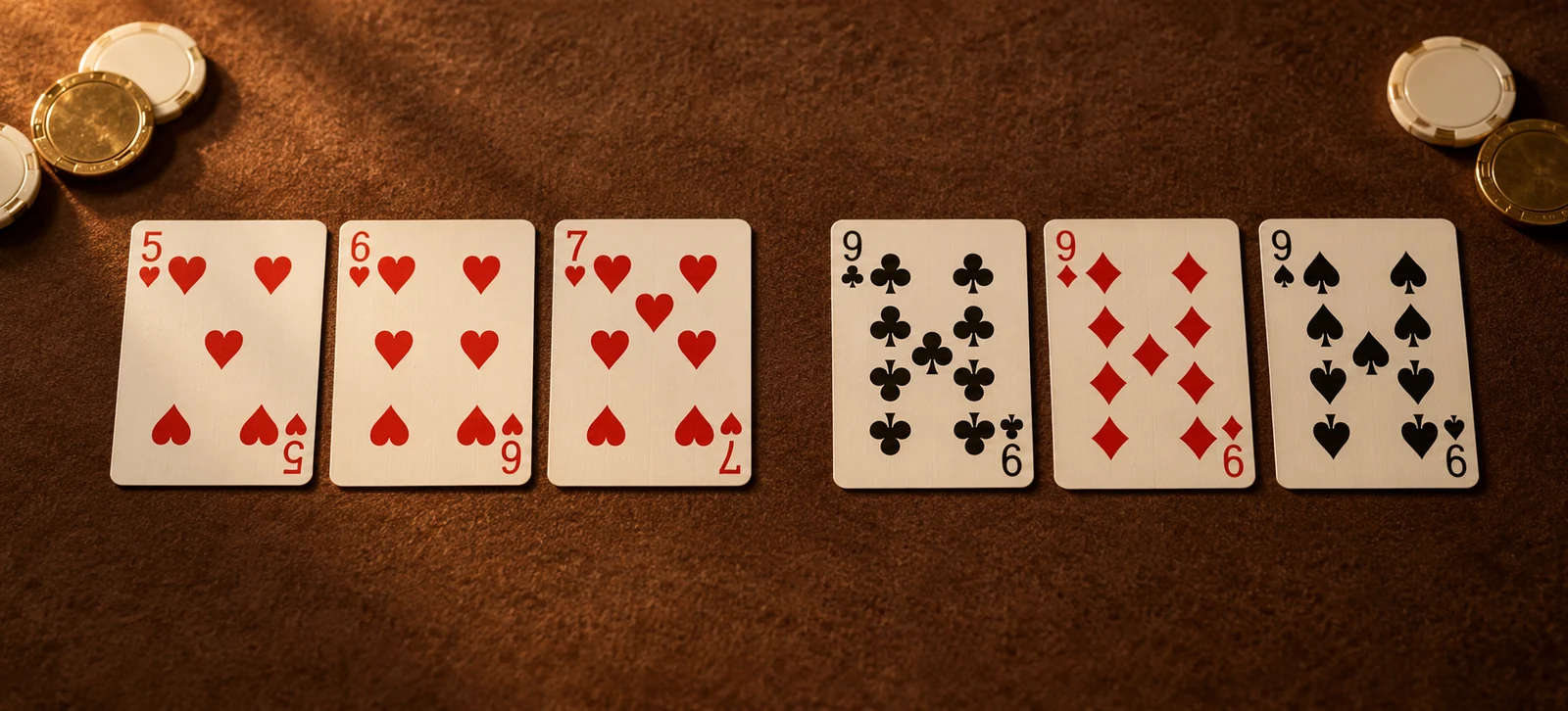
Teen Patti Royale publishes a descending hand order: Trail, Pure Sequence, Sequence, Color, Pair and High Card. A Trail holds three equal ranks, such as three nines. A Pure Sequence holds three consecutive ranks in one suit, such as 5, 6 and 7 of hearts, and it sits below a Trail.
A Sequence uses consecutive ranks across mixed suits, for example 8 of clubs, 9 of diamonds and 10 of spades. Color holds three cards of a common suit that do not run consecutively, such as 2, 7 and Jack of spades. A Pair carries two equal ranks, and High Card covers everything left.
A Pair of fours beats an unpaired King-high hand here, even though a single high card carries weight in other games. Reading the order before comparing avoids importing rules from a different format or product version.
TeenPatti Royale: Side show
A seen player may ask another seen player for a private comparison, known as a side show. The opponent can accept or refuse the request. Blind players sit outside this arrangement, so the private comparison only occurs between two players who have already viewed their three cards.
When the opponent accepts, the two hands are compared privately. The weaker accepted side-show hand leaves the round.
At a two-player showdown the stronger hand wins the pot. Ties are resolved against the player who requested the comparison, so the requester loses if the hands match. A tie between two Queen-high hands therefore settles in favour of the player who did not ask for the showdown.
These two mechanisms differ in scope. A side show removes one hand privately while others remain, whereas a showdown ends the contest between the last two players. A refusal keeps both players in the round, and the requesting player carries the tie risk if play later reaches showdown.
Evolution: Dealer qualification
Evolution's named-dealer TeenPatti gives the player three face-up cards and the dealer three face-down cards. The player's three-card hand is compared with the dealer's three-card hand. After the Ante, the player chooses a Play wager equal to the Ante, or folds and leaves the round.
The dealer must reach Queen-high to qualify. If the dealer does not qualify, the Play wager pushes and the Ante pays 1:1. When the dealer qualifies and the player's hand is higher, both Ante and Play pay 1:1. Equal hands push the main bets.
Pair Plus is a separate side wager on the player's own three cards, paying on a pair or better. The 6 Card Bonus instead assesses the best five cards from the combined six dealt, requiring three of a kind or better. Each side bet settles on its own cards.
The Ante Bonus requires a Play wager, so a folded player does not collect it. A player holding a strong three-card hand who folds forfeits that bonus route entirely.
Evolution: Matching ranks
Super Andar Bahar begins with a first-dealt Joker or reference card, and its rank becomes the rank to be matched. If that card is a 7 of hearts, every later 7 counts as a match, whatever its suit. The reference card sets the target rather than acting as a wild substitute in a Rummy hand.
After betting closes, cards go first to Andar and then to Bahar alternately until a matching rank appears. With a 7 as the reference, the first card lands on Andar, the second on Bahar, and the sequence continues. The side that receives the matching 7 wins the round.
Ten separate side-bet ranges concern how many cards follow the Joker: 1–5, 6–10 and so on through 46–49. A round where the matching 7 arrives as the fourth card after the Joker falls in the 1–5 band, while a match arriving as the eighth card falls in the 6–10 band.
One bet concerns whether Andar or Bahar receives the match; another concerns how many cards were dealt up to and including it.
RummyCircle: Valid groups
In the named 13-card Points Rummy example, a player arranges all thirteen cards into sets and sequences, with at least two sequences including one pure. A first-move drop costs 20 points, a later drop costs 40, and an invalid declaration costs 80.
Card values feed the losing score. Jacks, Queens, Kings and Aces count 10 each, numbered cards count their face values, and jokers count 0. A hand carrying more than 80 points of unarranged cards still records 80 rather than the full total.
With two decks, an identical card cannot be reused inside a set. A set holding a duplicated 7 of spades alongside a 7 of hearts is invalid, because repeated copies of one rank and suit do not form a valid set. Duplication across decks does not license reuse within one set.
Missing a pure sequence means all cards count toward the score. Holding a pure sequence without a second sequence excludes only that pure sequence from the count, so the remaining cards still score. A player with a pure run of 4-5-6 of hearts and no second sequence therefore counts the other ten cards.
RummyCircle: Pool scores
Pool Rummy runs across multiple deals with thirteen cards per hand. The winner of each deal receives 0 points, while the other players accumulate points. In 101 Pool Rummy, elimination occurs on reaching 101 points; in 201 Pool Rummy, the threshold is 201.
Drop costs differ between the two formats. In 101 Pool, a first drop costs 20 points and a middle drop costs 40. In 201 Pool, a first drop costs 25 and a middle drop costs 50. These figures are points recorded against a player, not rupees paid at a table.
A hypothetical cumulative score of 92 plus 12 gives 104. That total crosses the 101 threshold and triggers elimination, yet it remains below 201 and would not eliminate anyone in that format. The same accumulated points therefore carry different consequences depending on the pool chosen.
Each deal resets the cards but not the running totals, so points carry forward between hands. A player entering a deal on 92 points has little margin in 101 Pool, whereas a player on the same figure in 201 Pool continues. Thresholds apply to accumulated points only.
Read Indibet Slots or Indibet Live Casino for the other categories.
18+; T&C apply.
Game artwork references
Existing catalogue artwork from independent sources. The rule examples above retain their named providers; these images do not establish Indibet availability. PlayWSOP uses virtual chips for ages 21+ and offers no real-money prizes.